Vehicles & the Showroom
Your fleet is your earning power. The Showroom's current lineup runs from the starter compact to a 25-tonne tractor truck — and new classes keep arriving as the game grows. Every one of them is a different answer to the same question: which contracts do you want to exist for you?
The current lineup
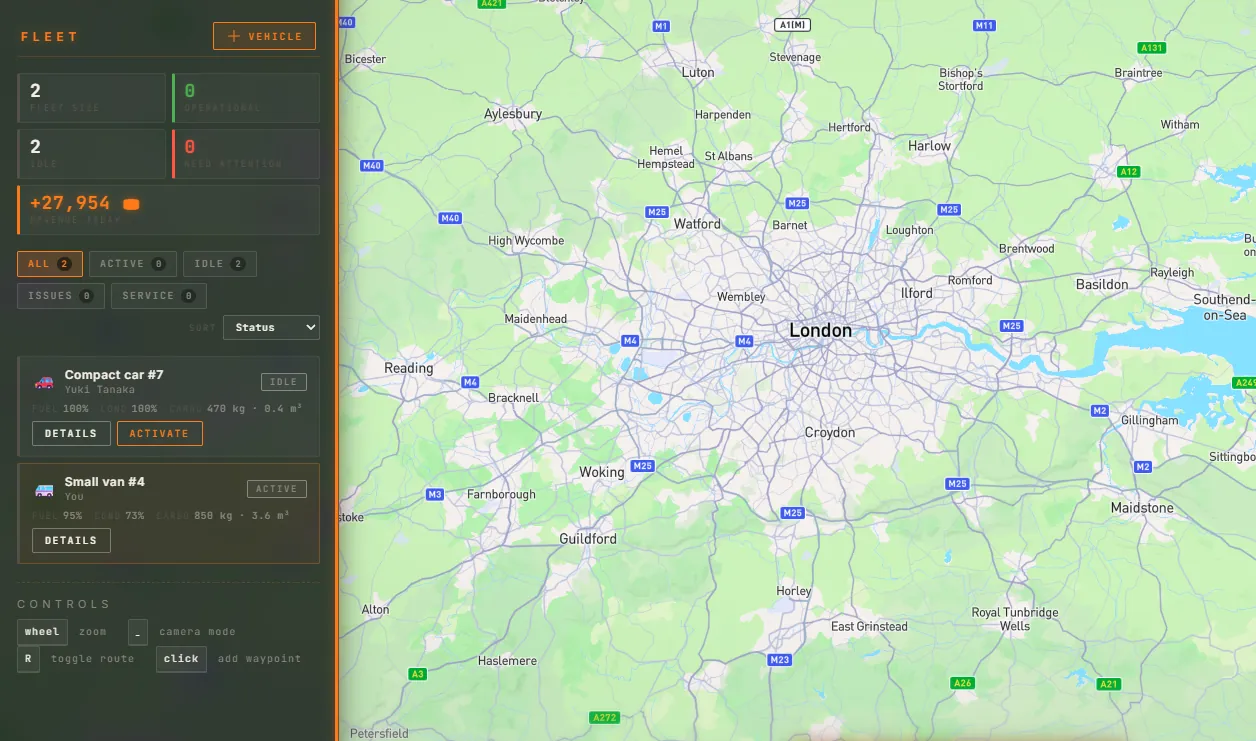
The classes currently sold in the Showroom (inside the Fleet panel):
| Vehicle | Payload | Volume | Tank |
|---|---|---|---|
| Compact car | 470 kg | 0.38 m³ | 42 L |
| Sedan | 530 kg | 0.55 m³ | 50 L |
| Small van | 850 kg | 3.6 m³ | 54 L |
| Medium van | 1,500 kg | 11 m³ | 75 L |
| Light truck | 6,500 kg | 36 m³ | 200 L |
| Heavy truck (tractor) | 25,000 kg | 90 m³ | 750 L |
| Refrigerated van | 900 kg | 4.0 m³ | 56 L |
| Tanker truck | 18,000 kg | 25 m³ | 450 L |
How to read the specs
Payload and volume are separate limits, and cargo hits whichever comes first. Furniture is bulky but light — a volume problem; construction materials are compact but heavy — a payload problem. The compact car and sedan share a deeper limitation: they carry solid cargo only. Vans and trucks open up perishable, fragile, and special loads, which is where the payout multipliers live.
Consumption is your steady cost. A heavy truck drinks several times what a sedan does over the same distance, and that bill arrives whether the trailer is full or empty. A big vehicle has to be earning big contracts to justify its thirst — park one between premium jobs and it quietly eats the profit the last run made.
Tank size sets your leash. How far a vehicle gets between stops is its tank divided by its thirst, and the two do not move together — a big truck carries a big tank precisely because it drains one so fast. Smaller tanks mean more planning around where the gas stations actually sit on your route.
The two specialists
- Refrigerated van — the only vehicle that can carry refrigerated cargo (frozen goods, ice cream). It is a small van with a cold box: modest capacity, but it owns an entire cargo category and its premiums.
- Tanker truck — the only vehicle for liquid cargo (fuel, chemicals), and liquids are the only thing it hauls; they never share with other loads. The upside: liquid cargo is immune to integrity damage, so a tanker run is about logistics, not babysitting.
The hidden line: repair costs
Vehicles wear with distance across six components — engine, transmission, suspension, brakes, tires, body — and repairs cost dramatically more at the top of the range. Repair pricing scales steeply by class: the compact car is the baseline, vans cost noticeably more, and the heavy truck is in a different league entirely per point of damage. A worn heavy truck is also more accident-prone, and its accidents are expensive. Budget for it before you buy it — this is the bill that catches out players who buy the biggest rig they can afford. Details in the fuel, wear & repairs guide.
Buying strategy by stage
- First upgrade: the small van. Cheaper than the sedan to buy, nearly ten times the cargo volume, and it unlocks perishable, fragile, and special cargo. This is the purchase that changes which contracts exist for you.
- Second vehicle vs better vehicle. Once you can hire drivers, a second modest vehicle earning in parallel usually beats one bigger vehicle standing idle between premium jobs. See the driver guide for the math.
- The medium van is the workhorse of the mid game — 11 m³ covers the great majority of city contracts.
- Specialists when the board says so. Buy the refrigerated van or tanker when you regularly see their cargo going unclaimed — you are buying a monopoly on those jobs.
- Trucks are an endgame commitment. Huge capacity and range, but heavy fuel, brutal repair bills, and they want a skilled driver. Put your best people in them.
Selling
Any vehicle sells back at half of what you paid, instantly. That makes experiments affordable but mistakes real — buying the wrong truck and undoing it is an expensive lesson. Selling mid-strategy is occasionally right, since a specialist that never finds work is dead capital, but the haircut means it should be a correction, not a habit.