Getting started: your first delivery
Your first ten minutes in Drive Your Way set the tone for the whole run. This guide walks you through exactly what you have, what to take, and how to turn a modest stake and one small car into the start of a real operation.
What you start with
Every new operation — guest or registered — begins the same way:
- A compact car with a full tank. It carries up to 470 kg and 0.38 m³ of solid cargo — think parcels and small boxes, not furniture.
- A starting float of cash. Enough for fuel and small setbacks, nowhere near enough to be careless.
- A welcome bonus of gems — the cosmetic currency. You do not need to spend it on anything to progress.
You start in a real city, on its real street network. You can play as a guest with everything unlocked; creating a free account later keeps your progress, and your guest state carries over.
Reading the contracts board
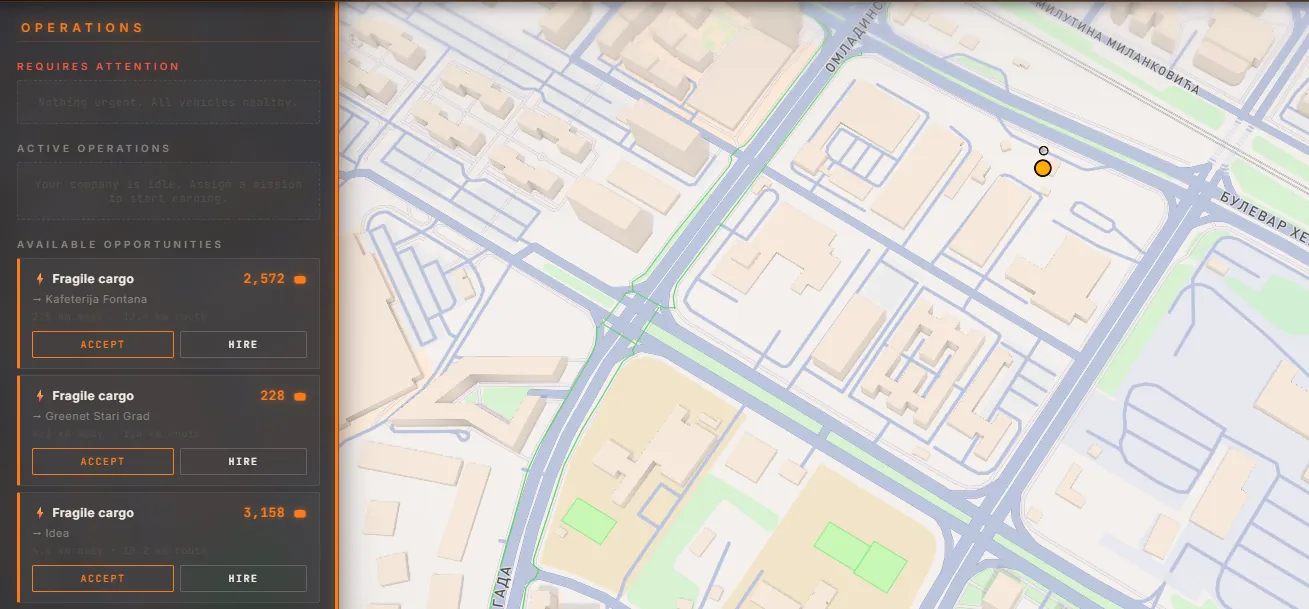
Open the Operations panel and look at the available opportunities. The board holds a rotating pool of about ten contracts, and you can refresh it a limited number of times per half hour, so read before you skip. For each job you care about four things:
- Cargo. Your compact car carries only solid cargo, and only small loads. Jobs whose cargo will not fit are not for you yet.
- Distance. Payouts scale with distance before multipliers — but longer runs tie up your only vehicle and burn more fuel.
- Payout. Shown up front. Compare it to distance to spot generous jobs — cargo type multipliers mean two 10 km runs can pay quite differently.
- Stops. Some contracts have several pickups or drop-offs. They pay a premium, but leave them until you know the streets.
The first run, step by step
- Pick a short, simple job — one pickup, one drop-off, a few kilometres, solid cargo. Reliability beats ambition on run one.
- Accept it and check the route. The mission panel offers Fast, Normal, and Economic route options with estimated time, fuel, and risk for each. Take Normal. (Why not Fast? It doubles your accident and cargo-damage risk — see the route planning guide.)
- Roll out to the pickup. Your car drives the route you picked — follow it with the camera, or zoom out and plan the next job. Loading takes a moment — roughly a minute per cubic metre of cargo, so small loads are quick.
- Deliver. Cargo condition at handover decides your pay: arrive at 90% integrity or better and you collect the full amount. On a short normal-route run in a fresh car, that should be routine.
Your first hundred kilometres
Early game money math is simple: a short parcel run in the compact clears a healthy margin, and the fuel for it is small change by comparison. Your only real threats are carelessness and impatience:
- Refuel on your terms. A planned stop at a gas station costs list price. Running dry means calling Emergency Assistance — marked-up fuel plus a dispatch fee, or a flat tow charge. Either one wipes out several deliveries of profit.
- Do not chase fragile cargo yet. Electronics and fragile loads carry the best premiums on the board, but a single accident takes a bite out of both your cargo integrity and your car's condition. In a cheap car with no cushion, boring cargo is good business — the premiums will still be there when you can survive them.
- String jobs in the same direction. Time driving empty is time earning nothing. Pick your next contract near your last drop-off when you can.
Your first big purchase
Save toward the small van. It is the cheapest step up and a huge one: 850 kg and 3.6 m³ of capacity against the compact's 0.38 m³, and it can carry perishable, fragile, and special cargo the compact cannot touch. That unlocks most of the contract board at a stroke. The sedan is cheaper to run per kilometre, but it is still a solid-cargo-only vehicle; the van changes what jobs exist for you. See the vehicle guide for the full comparison.
After around 20 completed missions you will also qualify to open your own company — the gateway to hourly drivers and running multiple vehicles at once. The driver guide covers when that investment pays.
First-session checklist
- Take 2–3 short solid-cargo runs on Normal routes.
- Refuel before the tank gets interesting.
- Bank toward the small van.
- Create a free account if you want the progress to stick.